Tibetan Serfdom: A Political Propaganda Used to Define Tibetans
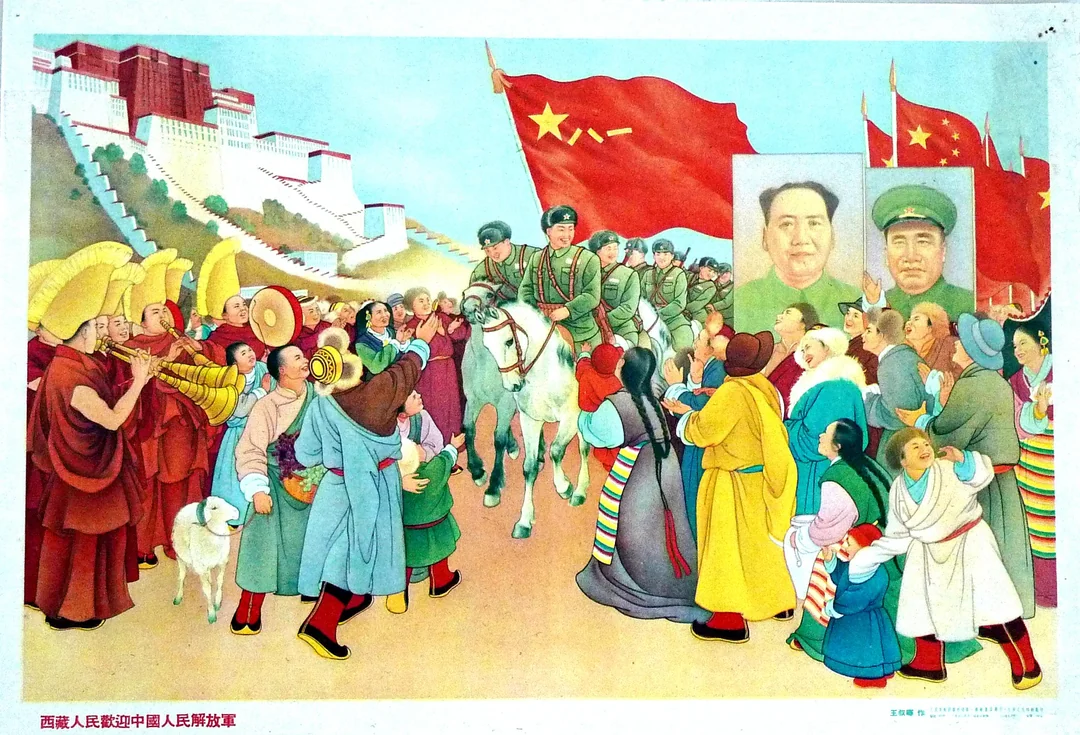
For decades, China has repeatedly described Tibet before 1959 as a society of “feudal serfdom” and portrayed itself as the force that liberated Tibetans from oppression.
The message is simple: old Tibet was a society of serfs, China abolished serfdom, and therefore Chinese rule brought liberation and progress.
But there is a fundamental question that deserves much greater attention:
If “serfdom” was the defining characteristic of Tibetan society, why does the experience of Tibetans outside Tibet tell such a different story?
Tibetans did not carry “serfdom” with them
After the upheavals of 1959, tens of thousands of Tibetans fled their homeland and established communities across India. By the 1990s, research documented approximately 65,000 Tibetan refugees in India, living across dozens of settlements and monasteries.
Tibetans subsequently established communities and institutions in countries around the world.
They built schools.
They established monasteries.
They created businesses.
They became teachers, academics, doctors, artists, entrepreneurs and professionals.
They developed democratic and community institutions in exile.
Most importantly, there is no Tibetan social institution outside Tibet that reproduces the alleged system of hereditary serfdom as a defining feature of Tibetan society.
Research on Tibetan economic activity in India and Canada has also documented Tibetan communities in which social hierarchy does not depend on hereditary status.
This does not prove that every aspect of traditional Tibetan society was egalitarian.
It does, however, raise an important question about the way China uses the word “serf.”
Was “serf” really a description of Tibetan identity?
The Tibetan word mi-ser is frequently translated as “serf” in discussions of Tibet.
But this translation has been disputed by scholars.
Michael Zrenner's study specifically asks why it is problematic to describe the mi-ser of pre-1959 Tibet as “serfs.” He notes that mi-ser referred to several socioeconomic groups among the non-aristocratic lay population and argues that economic mobility allowed many people to move beyond constraints that have been described as “serfdom.”
This is crucial because a social category is not the same thing as a permanent human identity.
Calling a Tibetan farmer a “serf” does not tell us everything about that person's actual economic position, social mobility, relationship with an estate, family circumstances or ability to negotiate obligations.
Even Melvyn Goldstein, the scholar most frequently associated with the argument that serfdom was pervasive in Tibet, acknowledged significant mobility within the traditional system. His research examined different statuses, including the institution of “human lease.”
Therefore, even within scholarship supporting the use of the term “serfdom,” the picture is more complicated than the simplified political slogan.
The Tibetan experience outside Tibet matters
This is where the Chinese narrative deserves particular scrutiny.
If serfdom is presented as something inherent to Tibetan society—as though Tibetans themselves were naturally trapped in a backward social order—then the history of Tibetans outside Tibet becomes highly relevant.
Tibetans who became refugees did not recreate a hereditary serf society in India.
Instead, they adapted to completely different social and economic circumstances.
They established settlements and schools.
They developed businesses and professional networks.
They created religious and cultural institutions.
They educated new generations.
They established political institutions in exile.
Oxford's research on Tibetan exiles in India describes the development of a long-term Tibetan exile community in India since 1959, with India hosting the world's largest Tibetan exile population and serving as the location of the Central Tibetan Administration.
A study of Tibetan refugees in India likewise documented the considerable changes in their social structure following displacement and their interaction with Indian and Western societies.
This experience does not erase the inequalities that existed in traditional Tibet.
But it demonstrates something important:
“Serfdom” was not an unchangeable characteristic of Tibetan people.
A society can change without becoming a different people
This distinction is frequently lost in China's presentation of Tibetan history.
Tibetans did not cease to be Tibetan when they left Tibet.
Their language, religion, cultural traditions, family networks and sense of identity continued.
But their social and economic circumstances changed dramatically.
If the alleged system of serfdom disappeared when Tibetans entered new political and economic environments, this suggests that the institution—where it existed—was a product of particular historical and institutional circumstances rather than an inherent feature of Tibetan identity.
This distinction matters.
A historical social structure should not be turned into a definition of an entire people.
Even the academic debate is not settled
There is no universal scholarly agreement that the word “serfdom” provides the complete or most accurate description of pre-1959 Tibetan society.
Goldstein argues that serf-like relations were pervasive and hereditary, while acknowledging mobility within the system.
Zrenner, by contrast, specifically challenges the characterization of pre-1959 Tibet as having “pervasive serfdom” and argues that the economic mobility of mi-ser complicates the use of the term.
That disagreement itself is significant.
Yet China's official narrative often presents the matter as though there were no historical debate at all.
The complicated question of Tibetan social organization becomes the much simpler slogan:
“China liberated one million Tibetan serfs.”
That is a political narrative, not a complete history.
From social history to political justification
The problem becomes particularly clear when the “serfdom” narrative is used to explain China's political control over Tibet.
The argument effectively becomes:
Traditional Tibet was oppressive.
China abolished that oppression.
Therefore Chinese rule over Tibet is liberation.
But these are three separate historical questions.
The first concerns Tibetan social structure.
The second concerns the political and economic transformation that followed China's takeover.
The third concerns political legitimacy and Tibet's status.
Evidence concerning one does not automatically prove the others.
Even if one accepts that serious inequalities existed in traditional Tibet, that fact alone cannot determine Tibet's political status or justify the permanent political subordination of Tibetans.
Tibet should not be defined by its worst historical features
Every society has chapters in its history that deserve criticism.
India has its history of caste discrimination.
Europe has its history of feudalism and serfdom.
The United States has its history of slavery and racial segregation.
But modern peoples are not defined exclusively by the worst institutions that existed in their historical societies.
The same principle should apply to Tibet.
Traditional Tibetan society deserves honest historical examination—including its inequalities.
But Tibetans should not be reduced to the label of “former serfs.”
Nor should the existence of historical inequality be used to suggest that Tibetans were incapable of governing themselves or developing their own society.
The real question
The real historical question is therefore not simply:
“Was there inequality in Tibet before 1959?”
There clearly was.
The more important questions are:
How extensive was it?
How should Tibetan social categories such as mi-ser be translated and understood?
How much social and economic mobility existed?
How did ordinary Tibetans actually experience the system?
And why has China transformed a complex historical debate into one of the central arguments for its rule over Tibet?
These questions deserve evidence rather than slogans.
Tibetans are more than China's historical description of them
Millions of Tibetans and their descendants now live in different parts of the world.
They have built communities, institutions, businesses, schools and professional lives far beyond the social structures of pre-1959 Tibet.
Their experience demonstrates that Tibetan society cannot reasonably be reduced to a single label.
Tibetans are not “serfs.”
They are a people with a history, culture, language, religion and political identity that cannot be defined solely by the social institutions of one historical period.
China may continue to repeat the phrase “liberation of the serfs.”
But Tibet's history deserves something more serious than a political slogan.
The history of Tibet belongs to Tibetans too-and it should be examined through evidence, diverse Tibetan voices and scholarship, rather than through a narrative designed to justify political control.