Protests Rock USA During Xi Jinping Visit as Tibetans Challenge CCP
Protests Rock Washington as Xi Jinping Visits the United States
Chinese President Xi Jinping’s September 2026 state visit to Washington brought not only diplomatic ceremonies and high-level meetings, but also some of the largest demonstrations against the Chinese Communist Party seen around a U.S. presidential visit in recent years. Tibetans, Uyghurs, Hong Kongers, Chinese democracy activists, Taiwanese supporters, Southern Mongolians and other critics of Beijing gathered across Washington to challenge Xi’s government and demand greater political and religious freedom.
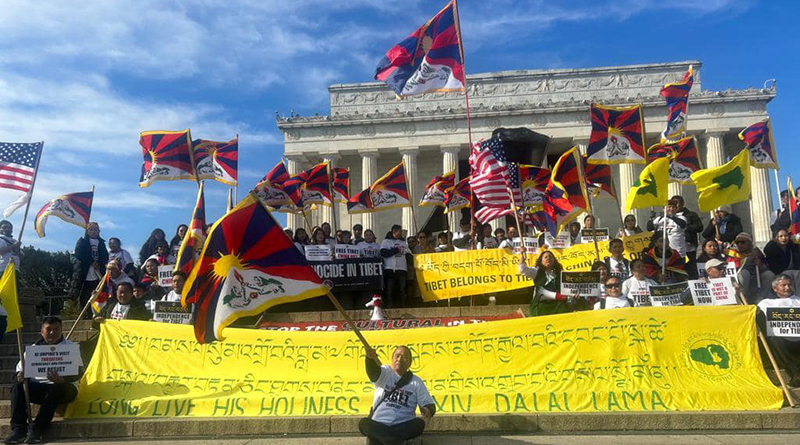
The protests became particularly significant for Tibetans. Thousands participated in demonstrations around the Chinese Embassy, the U.S. Capitol and areas near the White House. Tibetan national flags were highly visible, while demonstrators called for a Free Tibet and urged the U.S. government to raise Tibet, human rights and political prisoners during discussions with Xi. The International Campaign for Tibet reported that more than 2,000 Tibetan Americans participated in the September 24 mobilization, while The Diplomat reported that the broader coalition involved more than 3,000 people.
Tibetans Take Their Message to the Streets
For Tibetans living in North America, Xi’s visit was an opportunity to bring the Tibetan issue directly into the center of U.S.-China relations.
The September 24 demonstrations began outside the Chinese Embassy before protesters marched through Washington toward the U.S. Capitol. Tibetan protesters carried Tibetan flags and placards criticizing Beijing's policies in Tibet. They were later joined by Uyghur, Hong Kong, Chinese democracy, Taiwanese, Southern Mongolian and other groups.
The coalition reflected a common concern among different communities about restrictions on political expression, religious freedom, cultural identity and democratic rights under the Chinese Communist Party.
Tibetan organizations also called attention to China's policies of cultural and linguistic assimilation in Tibet, political imprisonment, restrictions on Tibetan Buddhism and Beijing's interference in the recognition of Tibetan Buddhist leaders. The protests also highlighted China's new Ethnic Unity and Progress Promotion Law, which came into effect in July 2026 and which Tibetan activists argue could accelerate assimilation policies. Chinese authorities describe the legislation as promoting ethnic unity and protecting minority rights.
Pro-Xi Demonstrators Also Mobilize
The demonstrations were accompanied by a separate mobilization of people supporting Xi and the Chinese government.
On September 24, hundreds of pro-Xi supporters gathered around Washington, including approximately 200 people outside the hotel where Xi was staying. They carried Chinese and American flags, played patriotic music and held banners welcoming the Chinese leader.
The two sides sometimes stood only a short distance apart, separated by police barricades.
At several locations, protesters and Xi supporters exchanged chants and insults. The atmosphere became particularly tense around Xi's motorcade route and locations connected to his visit.
On September 23, near Joint Base Andrews, supporters and opponents of Xi were involved in a physical confrontation. The Washington Post also reported fights near the air base, including an incident involving people fighting over an anti-CCP sign.
However, not every confrontation became violent. The Diplomat reported that later on September 24, police separated Tibetan protesters and Xi supporters near the White House with barricades. The groups shouted at each other, but that particular confrontation did not result in a physical altercation. (The Diplomat)
The Larger Question of CCP-Linked Pressure Abroad
The events surrounding Xi's 2026 visit also revived concerns about a broader issue: whether supporters connected to the Chinese Communist Party or Chinese state-linked organizations attempt to intimidate critics of Beijing outside China.
There is important evidence from Xi's previous U.S. visit that makes this question particularly relevant.
During Xi's November 2023 visit to San Francisco for the APEC summit, The Washington Post conducted a six-month investigation into confrontations between pro-Beijing groups and protesters representing Tibetans, Hong Kongers, Uyghurs and Chinese democracy activists. The investigation found numerous instances of harassment and violence against anti-CCP demonstrators. It reported that some pro-CCP activists attacked protesters with flagpoles, chemical spray, punches and kicks.
The Post also reported that Chinese diplomatic officials and state-linked diaspora organizations were involved in organizing pro-Xi demonstrations in San Francisco. According to the investigation, the Chinese Consulate in Los Angeles paid for hotels and meals for some supporters who traveled to the demonstrations, while Chinese diplomats were documented among pro-CCP groups during the four-day period.
These findings are significant because they go beyond ordinary disagreement between two groups of protesters.
Violence During the 2023 Xi Visit
The 2023 San Francisco events provide some of the clearest documented examples of physical attacks associated with pro-CCP groups during a Xi visit to the United States.
The Washington Post documented multiple assaults. In one incident, Chinese dissident Zhang Kaiyu and two companions were surrounded and beaten after an exchange with a group of young men. Zhang was briefly unconscious and was treated in an emergency room.
Another Chinese activist, Wang Wei, was attacked during an argument with people supporting the CCP. According to the Post's investigation, video showed him being jabbed with a flagpole and kicked in the head.
The investigation also documented an incident in which a glass bottle was smashed over a man's head and another in which chemical spray was used against anti-CCP protesters. In another confrontation, young Tibetan protesters were reportedly attacked by a larger group using sticks and metal rods.
The U.S. Congressional-Executive Commission on China subsequently called for an investigation into possible Chinese government involvement in the violence. The commission cited reports of protesters being attacked with metal rods, umbrellas and flagpoles and described the incidents as raising concerns about transnational repression.
China's embassy rejected accusations of responsibility. Chinese officials argued that people who had traveled to welcome Xi were themselves victims of provocation and violence. The embassy called for investigations into those incidents.
That distinction is important. Evidence from 2023 documents violence involving pro-CCP demonstrators and links some organizers to Chinese state or diplomatic networks, but that does not mean every individual supporting Xi or every confrontation can be attributed to the Chinese government.
A Pattern of Transnational Repression
The term "transnational repression" has increasingly been used by U.S. officials and human rights organizations to describe efforts by governments to intimidate, threaten or silence critics outside their own borders.
In the Chinese context, the concern is particularly relevant to Tibetans, Uyghurs, Hong Kong activists and Chinese dissidents living in democratic countries.
The Congressional-Executive Commission on China reported that during the 2023 APEC summit, pro-Party communities were reportedly mobilized through transportation, lodging and financial incentives. It also documented allegations that coordinated demonstrators harassed and physically attacked peaceful protesters.
Freedom House similarly warned ahead of Xi's 2026 Washington visit that Beijing's efforts to suppress critics and human rights defenders increasingly extend beyond China's borders.
The issue is therefore not simply whether supporters and opponents of Xi disagree. The more serious question is whether the Chinese state or organizations connected to it are using organized overseas networks to discourage Chinese, Tibetan, Uyghur and Hong Kong communities from exercising freedoms that are legally protected in the United States.
Washington Becomes a Stage for the Tibet-China Conflict
Xi's visit demonstrated that the Tibet issue remains deeply relevant even when the central focus of U.S.-China negotiations is trade, technology, Taiwan or strategic competition.
For the Tibetan community, the protests were a reminder that Tibet cannot simply be removed from discussions about China.
Tibetan activists argued that China's treatment of Tibet should be considered part of the broader U.S.-China relationship. Their demands included protection of Tibetan identity and language, religious freedom, the release of political prisoners and an end to policies they describe as forced assimilation.
The demonstrations also showed the increasingly interconnected nature of opposition to Beijing's policies. Tibetans stood alongside Uyghurs, Hong Kongers, Chinese democracy activists and Taiwanese supporters, creating a broader coalition around freedom, human rights and political self-determination.
What Happened During Xi's 2026 Visit Matters Beyond Washington
The protests surrounding Xi Jinping's September 2026 visit were about more than one diplomatic meeting.
They placed competing visions of China before the American public. One side presented Xi as the leader of a powerful country seeking stronger relations with the United States. The other used the same visit to highlight Tibet, Xinjiang, Hong Kong, Taiwan and the experiences of Chinese political dissidents.
For Tibetans, the streets of Washington became another international platform to challenge Beijing's narrative about Tibet.
The physical confrontations also highlight a broader concern. Peaceful political expression in the United States should not become subject to intimidation because the target of criticism is a foreign government. The documented events surrounding Xi's 2023 San Francisco visit demonstrate that this concern is not theoretical. The events of 2026 will require continued scrutiny to determine which confrontations involved ordinary clashes between opposing demonstrators and whether any organized groups connected to Chinese state interests again attempted to intimidate or physically target critics.
The message from the Tibetan demonstrations was nevertheless unmistakable: Tibet remains part of the conversation whenever the future of China's relationship with the democratic world is discussed.